DUNGEONS
Here is a small collection of dungeons.

Mock Soul is a game, shocker. The entire thing takes place in 'The Labyrinth', a cyclopean structure of impossibly large and extensive stone walls. So large, that they're almost a non-factor during your exploration of Mock Soul's world. Different areas of the labyrinth have their own biomes and climates, with communities of people living full lives without ever leaving one section of the labyrinth. Our goal isn't even to reach the end of the labyrinth, we're on a quest within its walls (except a brief interlude in the void). We don't know the true extent of the labyrinth, charting its unimaginable cross-dimensional reach would take too many lifetimes to count. So, can this be considered a dungeon? It's certainly a traditional dungeon-esque structure, but blown out to such a large scale that it begins to lose its original meaning. It's all well and good there being no escape from the labyrinth, but when there are multiple biomes inbetween its walls it doesn't feel very claustrophobic. That's where the mental strain of the labyrinth comes in, even in a physically open space the labyrinth is oppressive due to its relentlessly cruel atmosphere. The characters you meet in Mock Soul are almost always tragic or cruel, twisted devils or their victims. Magic within the labyrinth runs the risk of corrupting the user, a high concentration of magic will tranform them into a sadistic devil with no self control. The highest calibre of wizards are able to maintain a magic concentration of up to 60%, but most beings can't resist above 50%. Even these mighty devils aren't free in the labyrinth, they're vulnerable to being bound in magical rituals (involving blessed swords and bells), or by acquiring their tome - essentially a book containing a being's soul. It's through one of these tomes that we summon one of the key figures we meet on our journey - The Mad Guide. Once a human guide within the labyrinth's walls, he was driven mad and corrupted by magic - possessed to wander the labyrinth's depths with no further meaning. How deep? Well, there are dungeons within the labyrinth, with some of the coolest level design i've ever seen. The Inverted Web Castle is a dungeon found in a huge chasm formed by a sinkhole that swallowed a once prosperous kingdom, entirely made of painstakingly spun spiderweb. This is produced by Plumerina - the princess of the forgotten kingdom now corrupted by magic and turned into the fearsome Devil Princess, hanging dormant in her inner chamber until disturbed by you. Within her webby catacombs you'll find 'living' beings paralyzed by her venom and ensnared in her golden web, marionetted to be her gruesome royal guard. Apart from just being cool, the Inverted Web Castle is obviously physically much more claustrophobic than the surrounding labyrinth, it also manifests the psychological aspect of its torment. Plumerina's web ensnares those who lose themselves in the catacombs, forever cursed to be alone in the dark with no free will for eternity.
In a similar vein to Mock Soul, Vermis is a very similar game aesthetically and in terms of gameplay mechanics. However, Vermis does not take place in a labyrinth (no matter how big the labyrinth is), and instead a wide open world. Surprisingly, Vermis is fairly light on dungeons and the ones encountered tend to be quite typical dark fantasy fare, think crypts full of skeletons and misty swamps. Like Mock Soul, most of the characters you meet have been broken by this oppressive world. In the starting dungeon you meet two knights, one paralyzed by fear and the other in a grief-induced apathy. This is the entire driving force behind Vermis' morality system - good refers to those with the will to keep fighting while evil refers to those who have succumbed to the darkness and let the hopelessness embrace them. Perhaps the most 'good' character you meet is one you fight in combat - the Goblin Knight. His dedication to protecting his princess' resting place as repayment for her good deeds keeps him going, leading to one of the hardest fights in the entire game.
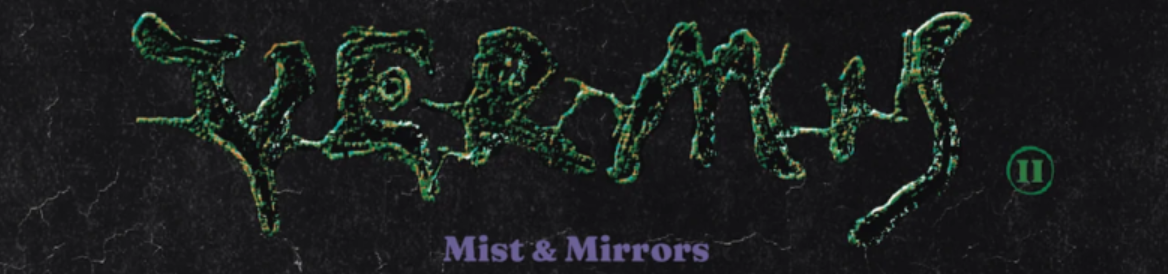
There is one dungeon that very much stands out though, and that is the Glass Purgatory. Almost the entirety of Vermis II - Mist and Mirrors takes place here, from the perspective of a specific character - The Wayfinder. Cursed by a purple rot that gradually spreads over his skin, he plunders ruins for valuable relics. This leads him to unknowingly enter the Glass Purgatory. This can only be entered by looking through eyes of glass, this entails using a huge ornate mirror to see the entrance, then entering while not taking your eyes off the reflection. When you start to hear voices behind you, you can now look away and will be in outer fringes of the Glass Purgatory. Turning back to the mirror will reveal that it has vanished, leaving a solid stone wall in its place. The theme of mirrors and reflection is (understandably) very strong within the Glass Purgatory, many passageways are hidden until viewed through a mirror or other reflective surface. You'll be doing a lot of backtracking to discover that the dungeon has shifted, making keeping a detailed map impossible. Many enemies fought also play off this theme of reflections, Zurigh is an egomaniacal wizard who took up residence in the Glass Hand Castle because every surface reflected his image dozens of times over, reflections he commands in battle against anyone who intrudes into his realm. The Glass Purgatory plays a lot of cruel tricks on you, damage taken in fights (and you will take damage from enemies with names like 'The Black Water Devourer') will appear to cause heavy damage like missing limbs, but then a reflection will show your unharmed body before revealing your fresh never-damaged limb right where it should be. It's hard to know what's real in the Glass Purgatory, this maddening sequence of illusions is where it plays its cruelest card. One twisted reflection leads out of the dungeon, into a forest containing a castle with the only true safe area in the game. You think you've finally finished the dungeon, it even seems like you enter another dungeon and continue with the game before mist envelops the room and you're back in the darkness of the Glass Purgatory. Despite how it may seem, the dungeon does end. If you can reach the Great Bell Tower, you'll face the game's final boss - you. At the tower's peak you'll find a miserable creature, headless and weak. It desperately tries to place heads scattered around the room on its stump, but all of them fall off. It's criminally easy to kill this creature, but doing so leaves you trapped in the Glass Purgatory forever. To 'beat' Vermis II, you have to decapitate yourself and place your severed head on this creature. Then, you are reborn. Your many wounds start flowing, pooling into a crimson puddle on the floor. Gazing within, you see your murky reflection, and hear a single bell toll. The illusion is shattered, and you awaken. You are sat staring at the mirror that started this all, withered and dehydrated. There's no telling how long you've been trapped in the illusion, but one thing is very clear. Your curse has receeded, there's not a trace of the purple rot on your skin. You are free.
Now, this might seem like a fairly basic concept. 'The real dungeon is in the mind, huzzah huzzah', but don't forget that i am not good at writing. i have not done these games justice, i would highly recommend playing the original games by the talented developers Salamander King (Mock Soul) and Plastiboo (Vermis). i should also mention that they are not developers, they are authors, because Mock Soul and Vermis are guidebooks for games that do not exist. This unique medium of fake video games creates a unique perspective that, in my opinion, is perfect for dungeons. Conventional media like movies and books suffer from a lack of interactivity, you are watching/reading characters in a dungeon rather than experiencing it for yourself. Games are interactive, but incredibly difficult to make and balance. They have to take mechanics into account, gameplay, story, being fun, it's a lot to manage. The more ambitious a game the more people are needed to develop it, but the more people involved take away from the original creator's idea. A fake game book creates the illusion of a game's interactivity while being far easier to make as a single person (Vermis' credits list just 5 people) - letting the author do what they want to do without having to worry about market trends and satisfying shareholders and other bs. They are a fantastic medium that i hopefully introduced you to with my post on Apple Quest, but a game that definitely is real is Scorn.
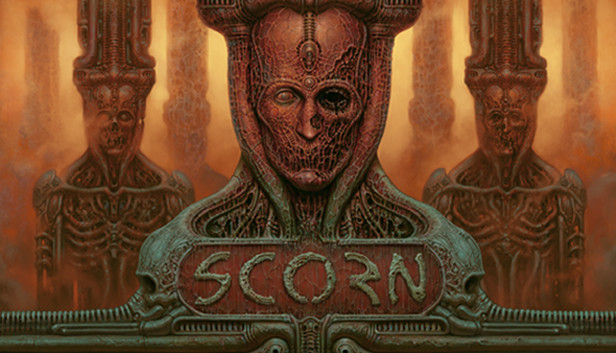
As a brief ending to the post, Scorn. Scorn is a game i played a while ago, and sacrifices nuanced gameplay for some incredibly evocative and grotesque imagery. The entire thing takes place in this purgatorial dungeon, it's unclear who you are or even what your purpose is. Most striking though, is the dungeon's distinct bio-organic design. Everything in the environment feels like it's at least partly alive, or made of bits that once were individual beings. Doors are muscle membranes opened by a polyp keypad, the floor is ribbed , even your weapons are bone and flesh plugged into your parasitic tail appendage. The true horror of Scorn is that you are not just in the dungeon, you are a part of it - the organic remnants of those before you is proof of this. You risk becoming assimilated into the dungeon's design, any progress you make involves permanently altering your body with biomechanical augmentations. You interact with movable objects by plunging your arm into a maw and interfacing with the dungeon, moving elements like another limb rather than a seperate entity. One of the game's opening puzzles involves using a fellow inhabitant of the purgatory as a resource to proceed - you extract it from its cocoon before implanting a key in its arm to open a locked door. It's now forever chained to that door, attached by its own arm as part of the dungeon. Even you (spoilers btw) don't escape this fatek, the first protagonist you play as turns into a parasitic organism that latches onto the second character you play - piggybacking for the majority of the game. It's only at the end when you extract your unwanted passenger and willingly super-lobotomise yourself to gain control over the exit's mechanical guardians. You assimilate with the dungeon for this control, seeing through the guardians' eyes as you carry your mutilated body to the exit. Shortly before your parasitic twin returns, taking advantage of your defenseless form to completely immobilise you and doom you to an eternity staring at the escape from your torment. Scorn is a very bleak game, the entire environment seems to be created for suffering. No questions are answered, no dialogue is dialogued, you and everyone else are doomed to become part of this unknowable nightmare forever.
Thank reading for. This post idea has been bouncing off both of my brain cells for a while now, i wasn't sure what approach i wanted to take. i fully wrote and deleted other sections before i settled on what i wanted to do, the main force of the post ended up being Mock Soul and Vermis. i think they give a unique perspective, and Scorn's world design is a refreshingly dismal look at the concept of a dungeon. i hope this was interesting, i didn't even talk about Guts vs the Sea God.