A teeny tiny guide to Apple Quest
Apple Quest is a little game with big appeal, and i hate this introductory sentence. Apple Quest is a nostalgic creature-collector that manages to keep the format fresh and interesting, standing out as a legitimate title while remaining faithful to its inspirations. Like the Pocket Man games, you have a team of little monsters that you take into battle on a vaguely threatening journey, but some key differences help it to stand out. Firstly, each monster has a star rating - corresponding to its individual strength. You have a maximum star capacity of 9, and you're free to split that limit however un/evenly you want. You can have a large team of what my friend Will would affectionately call 'shitters', or a limited unit of powerful monsters. You start with the lowly 1-star Apple Warrior, weak but he is the mascot after all and you can't start with the most powerful monsters that would be ridiculous have you ever played a videogame? Never question me again. You add monsters to your bestiary by finding them on your journey through Pommeland, while also completing special quests. You are free to swap your team around at any point outside of battles. Speaking of battles...
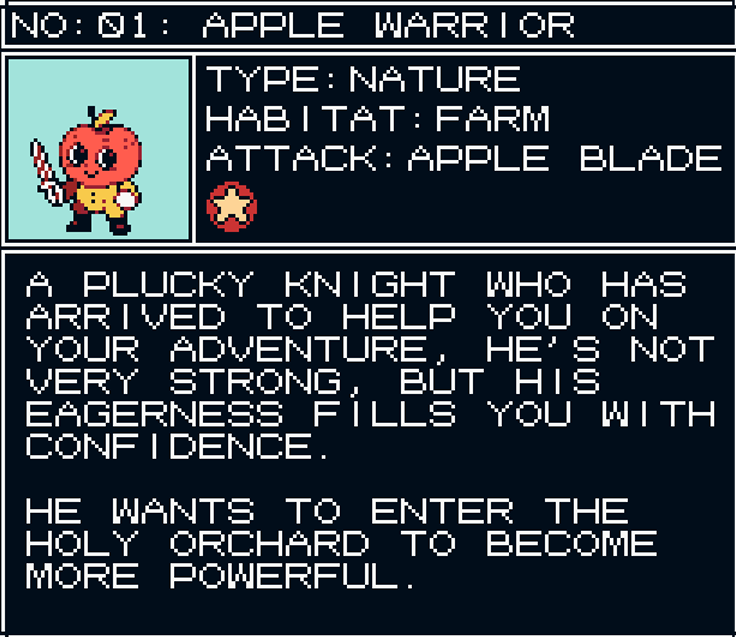
The battles in Apple Quest are probably what sets it apart from the creature-collecting competition the most, as it's entirely different from anything else i've seen in the category. Instead of turn-based battles, it plays pretty much likea side-scrolling 'tower' defense - think Battle Cats minus the mysterious £200 fee that appears out of nowhere. Enemy units advance towards your camp from their sinister evil lair, and you stop them by summoning the monsters in your team - who march diligently onwards and use their unique attack when in range. Apple Warrior's Apple Blade for instance is a sword attack, slashing at nearby enemies for small but reliable hit of damage. All monsters in the game have unique attacks, and almost all of them can be combined with others for additional effects. For example, Apple Warrior's rival Carrot Warrior's C-Spear will cause Apple Warrior to move and attack faster (and vice-versa) as neither can allow the other to beat them!
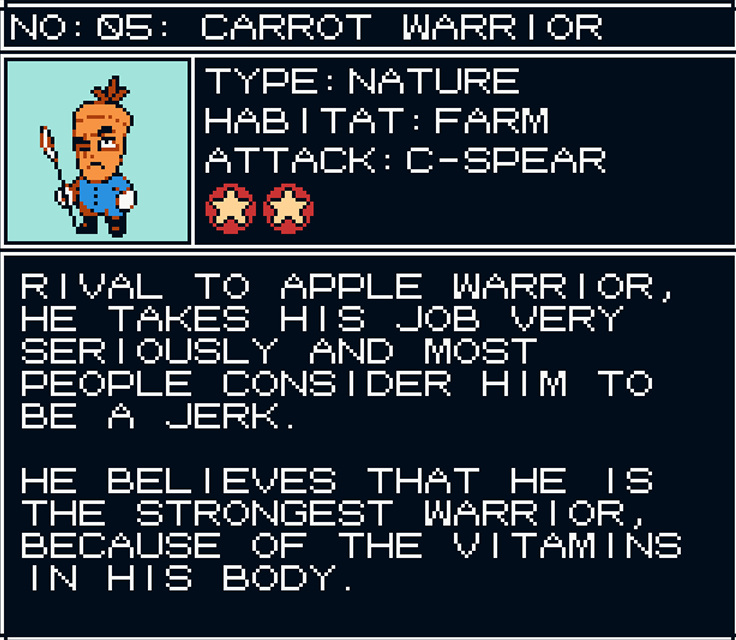
But, i hear you cry, what do those other words mean, Type and Habitat? Type isn't really like in Pokemon, there aren't any damage advantages or anything like that. Instead, different types will have synergies with the same type, or cool unique effects! For example Nature types will restore a little bit of health with each attack, increased by each Nature type currently on the battlefield. Habitat not only refers to the area you can find each monster in, but monsters will also gain a small boost when used in their home habitat. This favours swapping out and trying new team combinations, as you may need to use that boost in a tricky battle in a new region. Each monster comes with a short description, which are just delightful to read honestly.
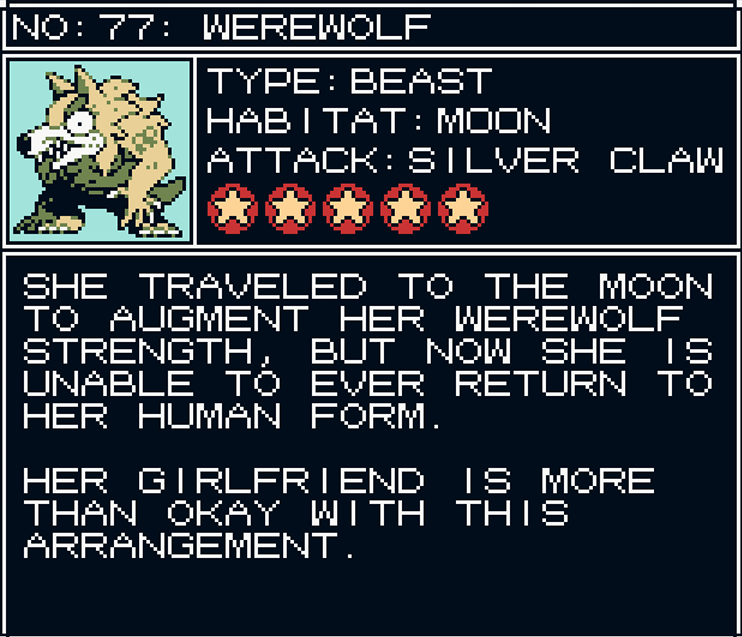
Apple Quest maintains its creature collector roots by allowing you to level up your monsters to make them stronger - most monsters can be levelled up 3 times. This is usually done by accumulating XP in battle, but some special monsters require you to complete a sidequest. Baphomet is a powerful boss monster that you want on your team because, well, why wouldn't you?
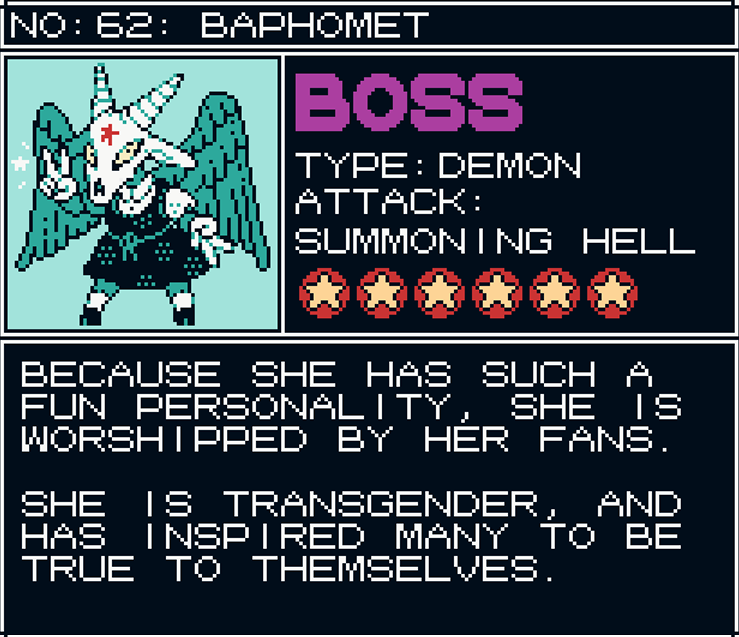
The only downside is that her star rating is a hefty 6, meaning you've only got 3 left over when you add her to your team. Completing her sidequest however lowers her star rating to 3, giving you much more room to craft a successful team.
Perhaps the most interesting thing about Apple Quest however, is that it doesn't exist. Well, it does exist, but not as a videogame. Apple Quest is a bestiary crafted by splendidland that describes a cast of monsters in a videogame that does not exist. As for the gameplay i described earlier, please see song 20 of the Portal 2 soundtrack.
So what's going on here? Why not just make a videogame? Well, because making videogames is really hard. By existing as a game guide, Apple Quest allows its creator to present ideas for a game that would either take ages or infinity to develop. The loose presentation of these 'rules' also allows for a LOT of flexibility and imagination in the eyes of the reader, all of the gameplay systems i described earlier are completely made up by me - barring the star limit which is the only rule the 'game' explicitly presents. The genre and mechanics are completely up for debate, this is just what i envisioned while reading, you could imagine something completely different. But why even make it a fake videogame? Wouldn't an encyclopedia of Pommeland done the same job? No. The 'player' envisioning mechanics is only possible in this hyper-specific medium, a simple encyclopedia wouldn't have the same effect in fleshing out each monster and even the wider world. This format essentially tricks the 'player' into doing most of the work when it comes to imagining Pommeland as a real place - creator splendidland has done the initial legwork but it's up to us to fill in the blanks.
Apple Quest is awesome, and it's only the tip of the iceberg when it comes to fake video games. They're such an AWESOME medium that can do things that nothing else can really do. i was introduced to the topic by SuperEyepatchWolf's video about them (he talks about Apple Quest too and much better than i can), and it started a weird obsession. i just think they're neat.